The data advantage in commercial underwriting, and why almost nobody has claimed it


In the early 1990s Progressive started pricing personal auto on information its competitors were not looking at. Credit history came first, then telematics, then behavioral data from wherever it could be sourced. The FTC later described the strategy in a report to Congress: Progressive used the risk-prediction models it had built to find drivers that other carriers were overcharging relative to the risk they actually posed, and sold those drivers the same coverage for less. Incumbents had to build the same capability or watch their best business leave, and credit-based scoring became standard across personal auto.
The compounding nature of a true data advantage is the core thesis of Shepherd. Progressive's Snapshot has been running since 2009 and has logged more than 100 billion driving miles. The miles improved the pricing, and better pricing brought in more of the drivers Progressive wanted. Progressive finished 2025 at an 87.4 percent combined ratio, a 12.6 percent underwriting margin against a long-term target of 4 percent, with net premiums written growing at roughly 16 percent a year since 2021. This year they passed State Farm as the largest private auto insurer in the country, ending a run State Farm had held since 1942.
The same opportunity in commercial insurance
A lot is now knowable about how a commercial contractor operates. Safety records and OSHA history are accessible via API, while project management and reality capture platforms on jobsites log everything from inspections to real-time near-miss reporting. Add sensor and camera data from active sites and a contractor's record on comparable projects, and you get a detailed picture of risk. Most of it sits in separate software platforms that underwriters never see.
Casualty loss trends are holding at 12 to 15 percent. Nuclear verdicts rose 52 percent in 2024, to 135 cases totaling $31.3 billion, and Swiss Re attributes a 57 percent increase in the cost of U.S. liability claims over the past decade largely to those awards. An underwriter working from a payroll breakdown of class codes from a static submission is making a severity bet with almost no information about the behaviors that drive severity, and will not find out whether the bet was sound for another seven to ten years.
Where the analogy breaks
Personal auto delivers Progressive millions of near-identical exposure units and losses that develop in months rather than years. Construction casualty offers more heterogeneous accounts, much lower claim frequency on lines like General Liability, and a tail that can run a decade, which means a flawed model can look like a good one for years. Anyone claiming a data edge in this line should be modest about how fast it proves out.
Consumer credit was also a single cheap variable available on every applicant from a bureau. Jobsite project management data has no bureau. It is fragmented across dozens of platforms, formatted inconsistently, and present on some accounts and absent on others. Building the pipes is most of the work, and it does not get easier with scale.
What has changed is how long the data has existed. Procore launched in 2002 and now supports more than $1 trillion in annual construction volume. Most of the other platforms in our program have been on jobsites for close to a decade or longer. Enough projects run on these tools have now closed out and moved through the full seven-to-ten-year tail that we can match how a job was run to how its claims developed. Ten years ago there wasn't enough history to run that study. Today there is, which is why we built Shepherd Savings around it.
The strongest objection is about causality. Contractors who run leading-edge products on their sites and connect the output to their insurance carriers may simply be better contractors, in which case an underwriter is measuring sophistication rather than risk, and the signal weakens as adoption spreads. We tested this by comparing the same contractors before and after adoption. Claims frequency falls 25 percent or more in the first year, and 40 percent once the tools are standardized across a project portfolio.
What we are building
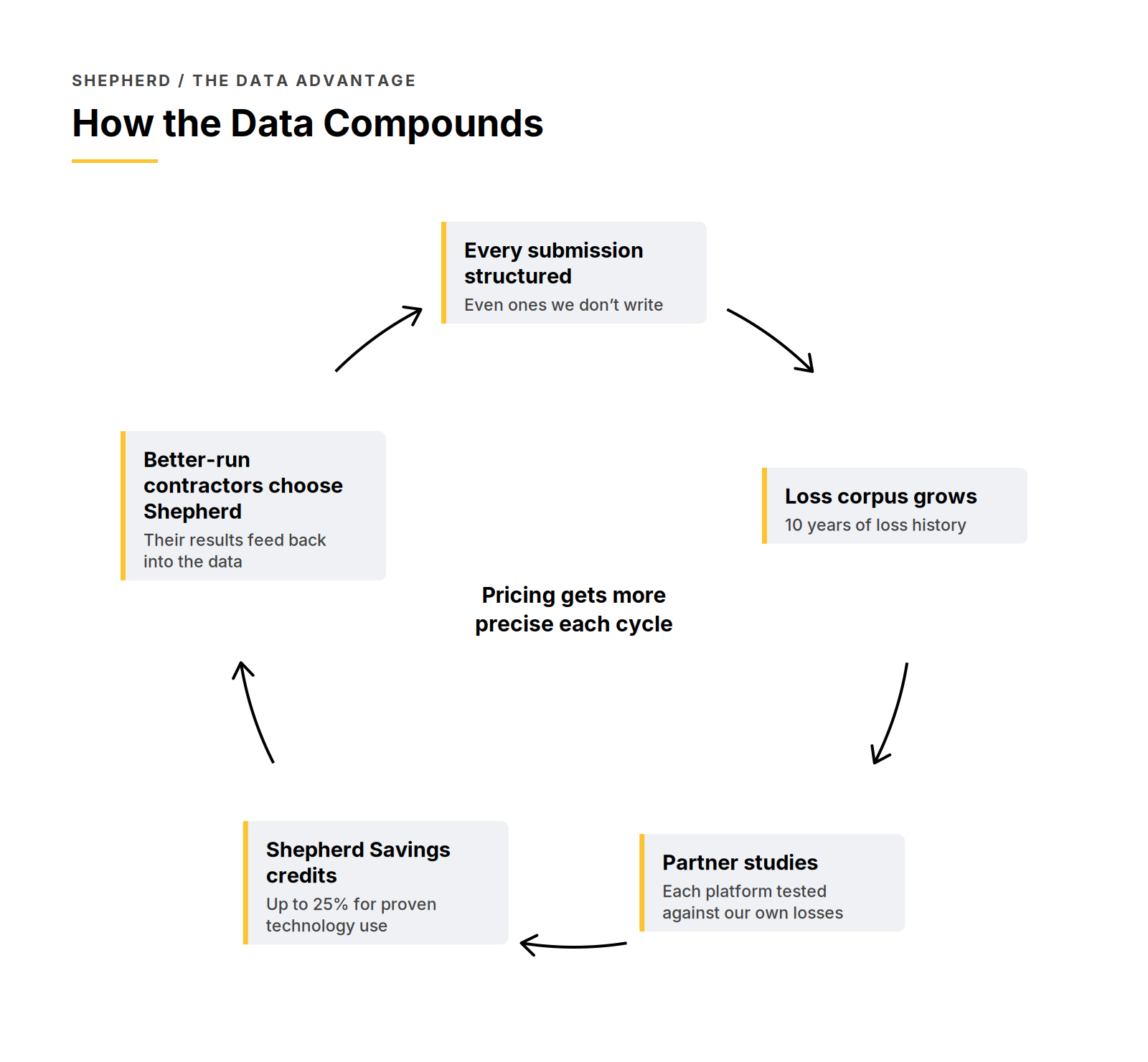
Our most valuable asset is the claims data. We structure every submission that comes through the door, including the large majority we don’t write, and five years of that has produced a construction and energy casualty loss corpus we can run real studies against. That lets our actuarial data science team test a hypothesis about jobsite behavior against real loss outcomes. Few carriers in this line have the data to do that.
We use that corpus to run Shepherd Savings. Contractors and owners running Procore, Autodesk, OpenSpace, Samsara, Raken, Brickeye, or DroneDeploy can earn premium credits of up to 25 percent, applied upfront at enrollment and adjusted at renewal as usage data accumulates. Each partner earns its place in the program by clearing a study against our own loss experience. We don't rely on vendor-supplied numbers. We recently published a DroneDeploy analysis of isolated projects running aerial mapping and 360 ground walks together, then compared loss outcomes against contractors using one modality or neither. Overall, DroneDeploy users experienced 44 percent fewer claims and 48 percent lower loss rates. Projects using both modalities saw a 51 percent reduction in loss rates. Link to the full study here. The question we're trying to answer is specific: which platforms, used in which ways, change loss outcomes enough to price against.
What comes next
Progressive grew from a nonstandard auto writer into the largest personal auto insurer in the country by pricing risk more accurately than anyone around it. Its competitors did not get to opt out. The drivers Progressive priced correctly left their old carriers, and the ones who stayed were, on average, worse risks at the old price. By the time the FTC reported to Congress in 2007, credit-based scores were in use across most of the auto market. The carriers that moved late spent years repricing books that had already been picked over.
Commercial lines are heading into the same pressure, with one difference. The data that separates a good contractor from a bad one is too large and too messy for people to work through by hand. A single construction submission can arrive as dozens of files. A contractor's jobsite record runs to thousands of inspections, daily logs, and sensor readings across every active project. Reading all of it, structuring it, and tying it to loss outcomes across an entire book is work AI can do and underwriting teams cannot do at scale. Without it, most of that data stays unread.
The carriers that win the next decade of commercial insurance will be the ones that can connect jobsite data to loss outcomes and update their pricing as new claims patterns develop. That takes a platform designed around AI from the start. Adding a model to a manual workflow still leaves the manual workflow setting the pace.
Carriers that keep pricing from a static application will still write business. Over time, more of it will be the accounts that better-informed markets passed on, and the evidence will show up years later in loss development. That is the same pressure that rebuilt personal auto, and it will push commercial lines to rebuild around data and AI. Carriers can build that capability now, or build it later in response to their own loss ratios.
The compounding is slow at first. Five years in, we're more convinced of this thesis than when we started.